


Introduction to Guitar Effects That Mimic the Human Voice
The idea of creating a guitar effect that mimics a voice has fascinated players for decades. Guitarists often look for ways to make their instrument feel more expressive—almost like it’s speaking, singing, or responding emotionally. This type of voice-like guitar effect adds personality and makes a performance stand out because it blends familiar vocal character with the raw power of electric guitar tone.
Guitar effects that mimic a voice give your instrument a truly expressive and unique character. A voice-like guitar effect allows your guitar to sound almost like a human voice, creating singing or talking tones that bring riffs and solos to life. Using pedals like a guitar talk box effect, vocal synth guitar effect, or vowel filter guitar effect, players can shape vocal-style guitar tones with smooth vowel sounds, formant shaping, and dynamic modulation.
With proper signal chain and pedal routing, you can capture natural resonance and expressive riffs using a microphone or amp. These effects let you create singing-like tones, subtle vocal movements, and harmonic textures, whether in rock, funk, or experimental music. Adjusting tone, EQ, and gain ensures clarity, while creative pedal use adds musical expression, rich sonic character, and engaging performance dynamics.
What This Effect Is and Why Players Use It
A guitar effect that imitates vocal characteristics shapes the signal to sound like a human voice guitar sound, adding vowel-style resonance, expressive movement, and speech-like articulations. Players love it because it creates a vocal-style guitar tone that can sing, cry, or even talk, making the guitar feel more connected to the audience on an emotional level.
A Brief History of Vocal-Like Guitar Tones in Modern Music
In the early days of rock, musicians experimented with amps and pedals to create guitar sounds that imitate speech. By the ’70s and ’80s, artists like Peter Frampton and Joe Walsh brought the guitar talk box effect to mainstream audiences, proving that the guitar could sound almost human. Over time, new technology introduced vocal emulation guitar pedals, vowel filters, and vocal synths, each offering different ways to shape guitar tones into voice-like forms.
How Guitar Effects Can Imitate the Human Voice

These effects copy the natural movement of vowels and vocal resonance by filtering and shaping the guitar’s frequency range. By boosting certain tones and reducing others, the pedal recreates sounds similar to “ah,” “oh,” or “ee.” Some effects also respond to picking dynamics, making the guitar sound expressive in the same way a voice changes with breath and emphasis.
Understanding Vowel Shaping
Human speech is built on vowel resonance—“A,” “E,” “I,” “O,” and “U.” Guitar pedals use vocal resonance filters and formant shaping to mimic those vowel movements. When a pedal shifts the resonance peaks, it creates a guitar effect that creates vowel sounds, which is the foundation of voice-like tones.
How Modulation and Filtering Create Vocal-Style Movement
Effects like auto-wah voice effects, envelope filters, and formant filters use dynamic vocal modulation to shape the tone as you pick. This movement can sound like singing notes or subtle vocal inflections, creating a lively and expressive sound.
Why Certain Frequencies Resemble Spoken Sounds
The human voice uses specific frequency ranges. When a pedal boosts or sweeps through those ranges, it triggers the brain to perceive a “speaking” or “singing” tone. This is why guitar effect that talks devices feel lifelike—they work within the same resonant bands the mouth naturally creates.
The Most Popular Guitar Effect That Mimics a Voice
The talk box is the most famous effect known for producing a truly human-like vocal sound. It routes the guitar signal into a tube that sends the sound into the player’s mouth, allowing them to shape words and syllables naturally. This classic effect has been heard in countless iconic solos and remains the top choice for players wanting a voice-like tone.
Talk Box Explained in a Simple Way
The talk box is the most iconic guitar effect that mimics a voice. Unlike typical pedals, it sends sound through a tube into the player’s mouth, letting the guitarist shape words using lips and tongue movements. Because it uses actual mouth resonance, it produces the most realistic guitar effect that sounds like singing.
How It Works and Why It Sounds Like Singing
Here’s the simple breakdown:
The guitar sends sound to a small speaker in the talk box.
The sound travels through a plastic tube to the player’s mouth.
The guitarist shapes vowel movements silently.
A microphone picks up the resulting sound.
This creates a speech-like guitar tone, making it seem as if the guitar itself is talking.
Famous Songs Known for Using the Talk Box
Some of the most iconic uses include:
“Do You Feel Like We Do” – Peter Frampton
“Livin’ on a Prayer” – Bon Jovi
“Rocky Mountain Way” – Joe Walsh
“California Love” – Roger Troutman
These songs made the guitar talk box effect instantly recognizable.
Other Guitar Effects That Create Vocal-Style Sounds
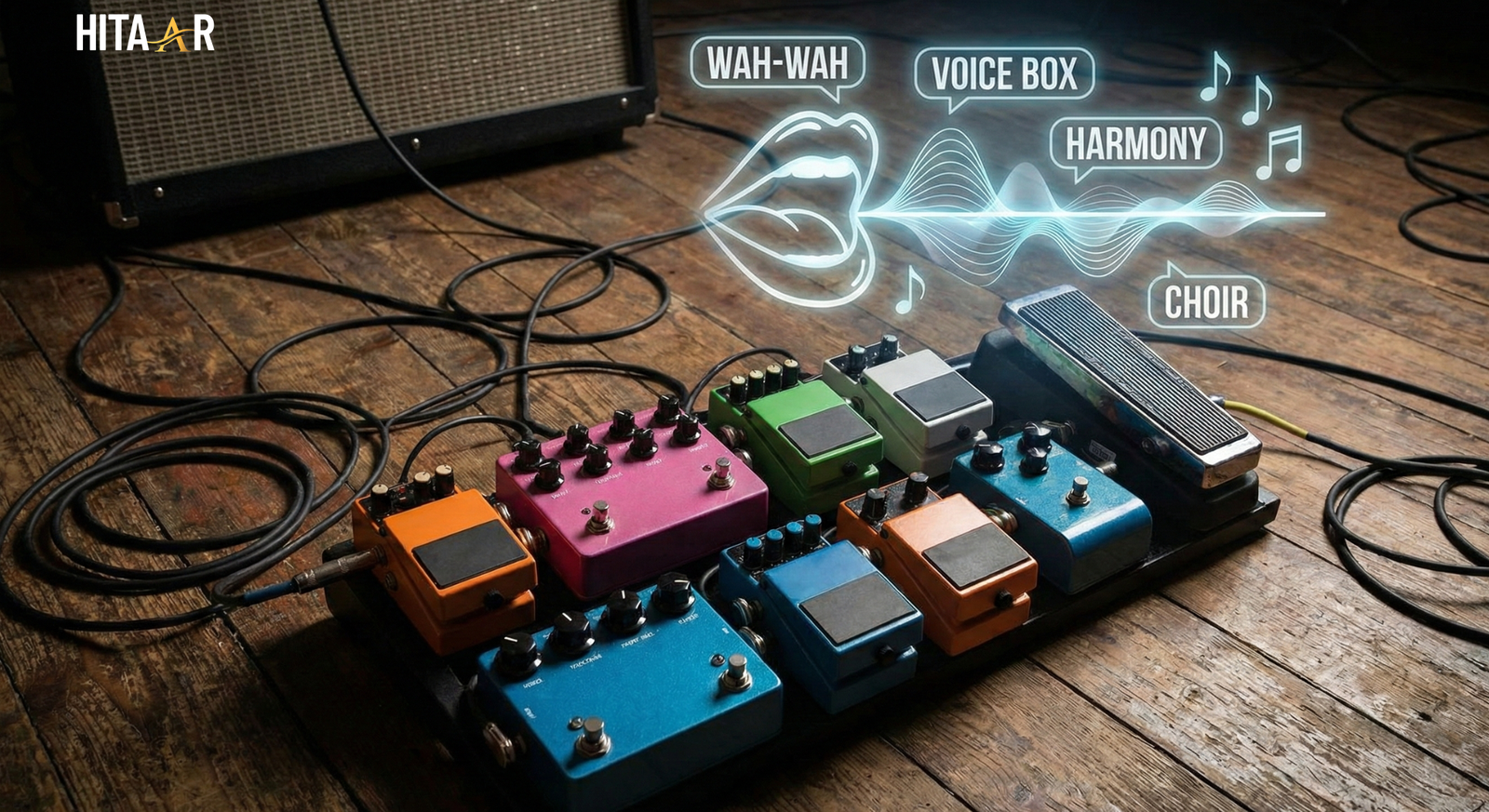
Besides the talk box, several modern effects can deliver vocal-style tones. Vocal synth pedals can generate robotic or smooth singing-like textures, while formant-shifting pedals shape the sound into different vowel tones. Even wah pedals can add a subtle, vocal-like “cry” effect, giving players multiple options for expressive sounds.
Auto-Wah Pedals and Vowel Filters
An auto-wah vocal effect reacts to your picking strength, adding vowel-like sweeps. A vowel filter pedal expands this by shaping “A-E-I-O-U” formants more clearly.
Envelope Filter Pedals and Dynamic Tone Shaping
Envelope filters track the input signal and generate a funky, expressive, vocal-style guitar tone often heard in funk and R&B. This creates a smooth envelope filter vocal tone that can feel like the guitar is whispering or sighing.
Formant-Shifting Effects and DSP Vocal Emulation
Modern pedals use digital processors to shift formants. A formant filter guitar pedal or vocal synth guitar effect can create robotic voices, choir-style tones, and even cartoon-like vocal movements.
Talk Box vs. Vocal Synth vs. Wah Pedal
A talk box produces the closest natural voice effect because it uses your mouth as the sound filter. A vocal synth relies on digital processing and can create both realistic and synthetic vocals. The wah pedal is simpler, giving a sweeping vowel-like movement but not forming actual words. Your choice depends on whether you want authentic vocal tones or modern digital variations.
Here’s a clear comparison of the three most common voice-mimicking guitar effects:
Comparison Table
| Effect Type | Closest to Human Voice | Difficulty Level | Best For | Sound Character |
|---|---|---|---|---|
| Talk Box | ★★★★★ Most Realistic | Intermediate | Classic speech-like tones | Natural, lifelike |
| Vocal Synth | ★★★★☆ Very Close | Easy | Modern, robotic vocals | Smooth or electronic |
| Wah Pedal | ★★★☆☆ Moderate | Easy | Expressive leads | Vowel-like, sweeping |
Differences in Tone
Talk Box: Most realistic voice imitation
Vocal Synth: Clean, controlled, electronic-style vocals
Wah Pedal: Classic vowel sweep but less like speech
Which Sounds Closest to an Actual Human Voice?
The talk box remains the closest to a real vocal sound.
Pros and Cons for Each Effect
Talk Box
✓ Realistic speech
✗ Needs mic + amp routing
Vocal Synth
✓ Easy to use, versatile
✗ Less natural than talk box
Wah Pedal
✓ Great for solos
✗ Not true vocal mimicry
How to Use a Talk Box for Voice-Like Guitar Tones

To use a talk box effectively, you place the tube near your mouth and let your mouth shape the sound just like speaking or singing. By moving your jaw and tongue, you create expressive syllables and vowel tones. It takes practice, but once mastered, it produces one of the most realistic voice-like guitar sounds available.
Simple Beginner Setup
If you want how to make guitar talk, here’s the simplest setup:
Guitar → Amp → Talk Box → Tube → Mouth → Microphone → PA System
Safe and Effective Routing (Amp → Talk Box → Mic)
Plug the guitar into the amp
Send amp speaker output into the talk box
Place the tube near your mouth
Use a vocal microphone to capture the shaped sound
This routing prevents damaging your amp and ensures clean, powerful tones.
Tips to Get Clean, Expressive “Speech-Style” Sounds
Keep your mouth wide for clearer vowels
Avoid too much gain—distortion muddies speech
Practice slow vowel movements first
Add a subtle delay to enhance vocal clarity
This makes the speech-like guitar sound stand out during solos or fills.
Best Pedals for Achieving Voice-Like Guitar Effects
Several pedals are designed to help players create vocal-style tones with minimal setup. These include formant filters, vocal synth units, multi-effects processors, and advanced wah variations. Each pedal offers different levels of control, allowing you to dial in subtle vowel shifts or dramatic, singing-like tones depending on your style.
Top Talk Box Models
Heil Sound Talk Box
MXR Talk Box
Danelectro Free Speech
These are widely considered the best talk box for guitar options.
Best Vocal Synth Pedals
Electro-Harmonix V256
Boss VO-1
TC Helicon VoiceTone Synth
Great choices for players who want a vocal synth pedal for guitar.
Best Vowel/Filter Pedals
Source Audio Spectrum
EarthQuaker Devices Spatial Delivery
EHX Q-Tron
These are ideal for shaping expressive vowel filter guitar effects.
Sound Examples and Genres Where Voice-Mimicking Effects Shine

Voice-mimicking effects are commonly used in rock, funk, blues, electronic music, and experimental genres. They shine in guitar solos, melodic hooks, and expressive rhythm sections. Whether you want a soulful vocal tone or a futuristic robotic sound, these effects help your guitar stand out with emotional character.
Rock
Classic talk box tones, expressive solos, dramatic vocal-guitar blends.
Funk
Envelope filters and vowel filters add rhythmic “talking” textures.
Pop
Modern vocal emulation guitar pedals add futuristic tones.
Modern Experimental
Formant filters and voice modulation create spacey, alien-like sounds.
Artists influenced by these effects include:
Peter Frampton
Joe Walsh
Slash
Roger Troutman
Bon Jovi’s Richie Sambora
Common Mistakes Guitarists Make (And How to Fix Them)
Many players overuse the effect or pair it with harsh distortion, which can make the vocal tone unclear. Others forget to adjust EQ settings, resulting in muddy or weak sounds. By balancing gain levels, practicing subtle movement, and choosing the right pedal settings, you can achieve a clean, expressive, and natural voice-like tone.
Wrong Signal Chain
Always route talk boxes correctly. Wrong routing can damage gear.
Using the Wrong Amp or Mic Setup
Small practice amps struggle with talk box power. Use proper wattage.
Overusing Resonance or Gain
Too much gain removes clarity, especially in vocal-style tones.
visit more article related chods click here
Final Thoughts: Choosing the Right Vocal-Style Effect for Your Playing
The best voice-mimicking effect depends on how natural or modern you want your tone to be. If you want classic vocal expression, a talk box is unbeatable. For creative digital options, vocal synths and formant pedals work beautifully. Choose the tool that matches your style, experiment with settings, and let your guitar “speak” in a way that enhances your musical voice.
Which Effect Is Best for Beginners?
A vocal-sounding guitar pedal or vocal synth is easiest for new players.
Which Effect Is Ideal for Stage vs. Studio?
Live: Talk box for dramatic visuals
Studio: Vocal synths and formant filters for cleaner tracking
How to Match Your Pedal to Your Music Style
Rock → Talk Box
Funk → Envelope Filter
Pop/Electronic → Vocal Synth
Experimental → Formant Filters
Whether you want subtle vowel shaping or a full-on guitar effect that imitates human voice, today’s pedals make it easier than ever to add expressive, vocal-style magic to your guitar tone.


Pingback: Is It Easy To Learn Guitar Or Piano Find The Best Choice For You - Hitaar