
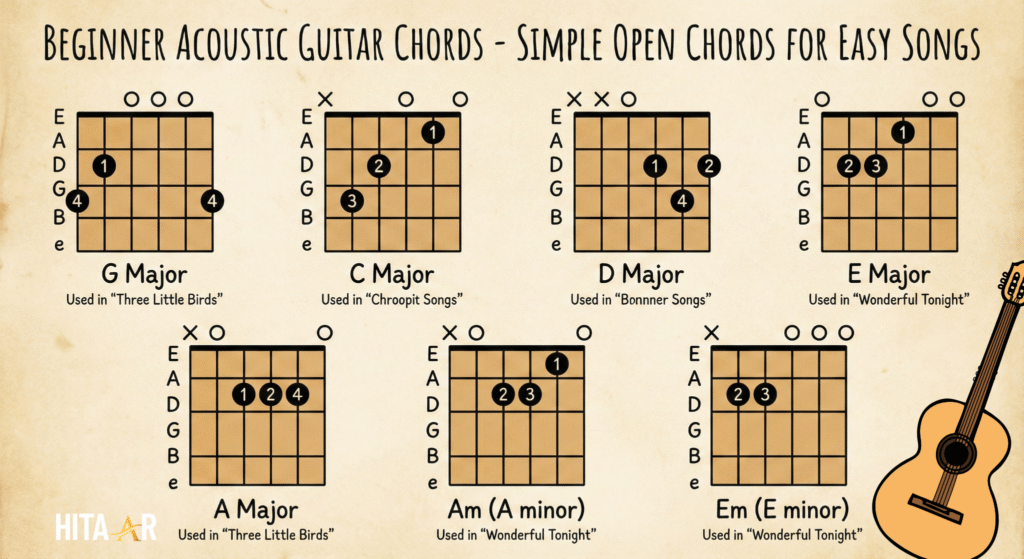

Acoustic guitar chords are the building blocks of nearly every song you love — from folk and country to rock and pop. Knowing how chords work (open chords, barre chord shapes, add9s, and altered tuning shapes) lets you play songs, write progressions, accompany singers, and move into fingerstyle and chord-melody arrangements. For beginners, mastering a set of core chords and simple strumming patterns unlocks hundreds of acoustic guitar songs.
Key benefits:
Instant ability to play songs (Beatles, Bob Dylan, Tom Petty, John Denver).
Better rhythm and strumming (beat, groove, pattern).
Foundation for fingerpicking, chord-melody, and songwriting.
Easier to learn tabs and video lessons once chord knowledge is strong.
What is a chord? (Simple, non-technical)
A chord is two or more strings played together that form a harmony. Most popular acoustic guitar chords are triads (three notes: root, third, fifth). Chords can be major (happy), minor (sad), suspended (open), or extended (add9, 7, maj7). The same chord shape can be moved up the neck (capo or barre) to change key.
(Include keywords: root, chord shapes, capo, open strings, tuning.)
Essential open chords (first chords every beginner should learn)
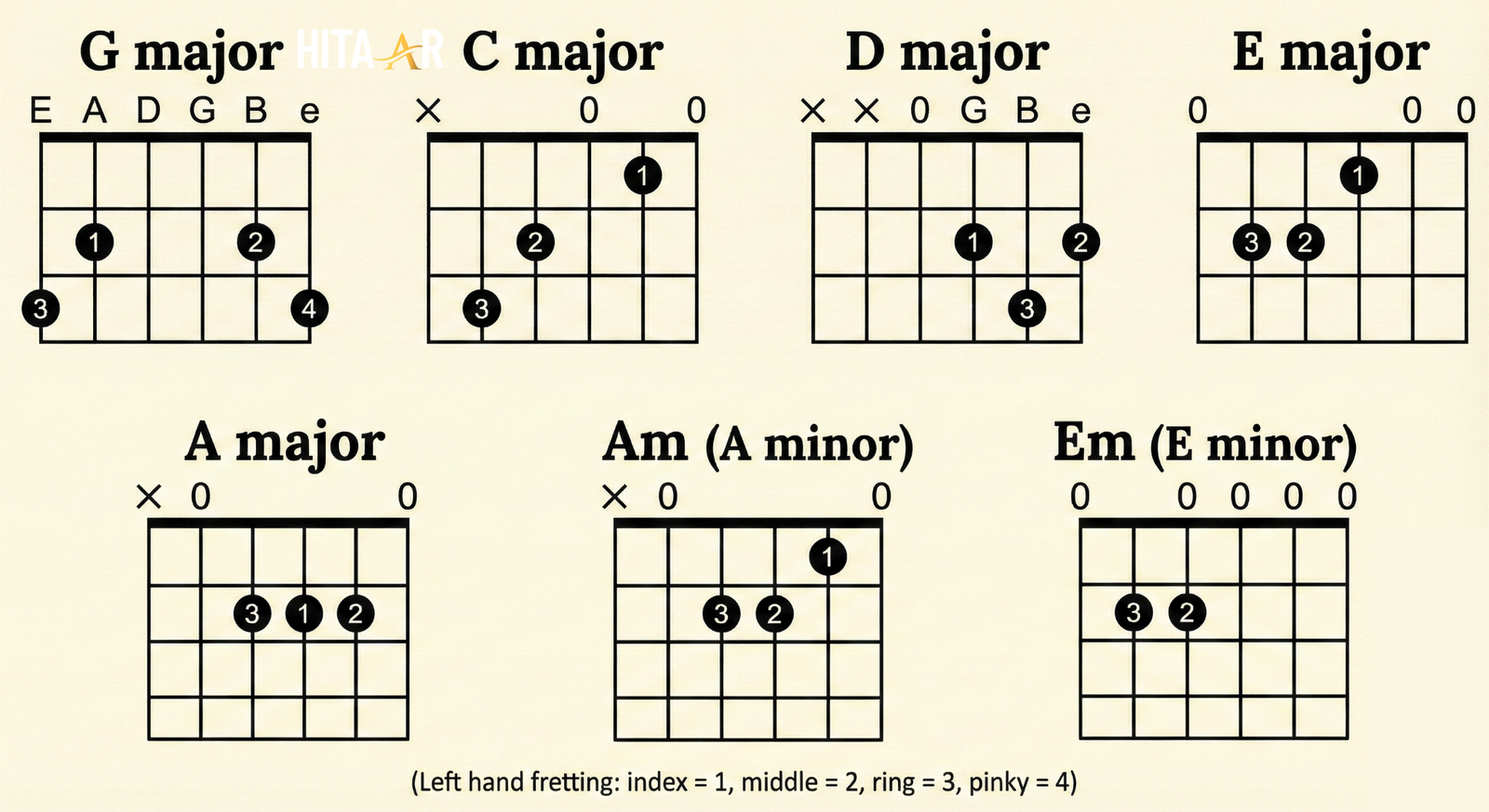
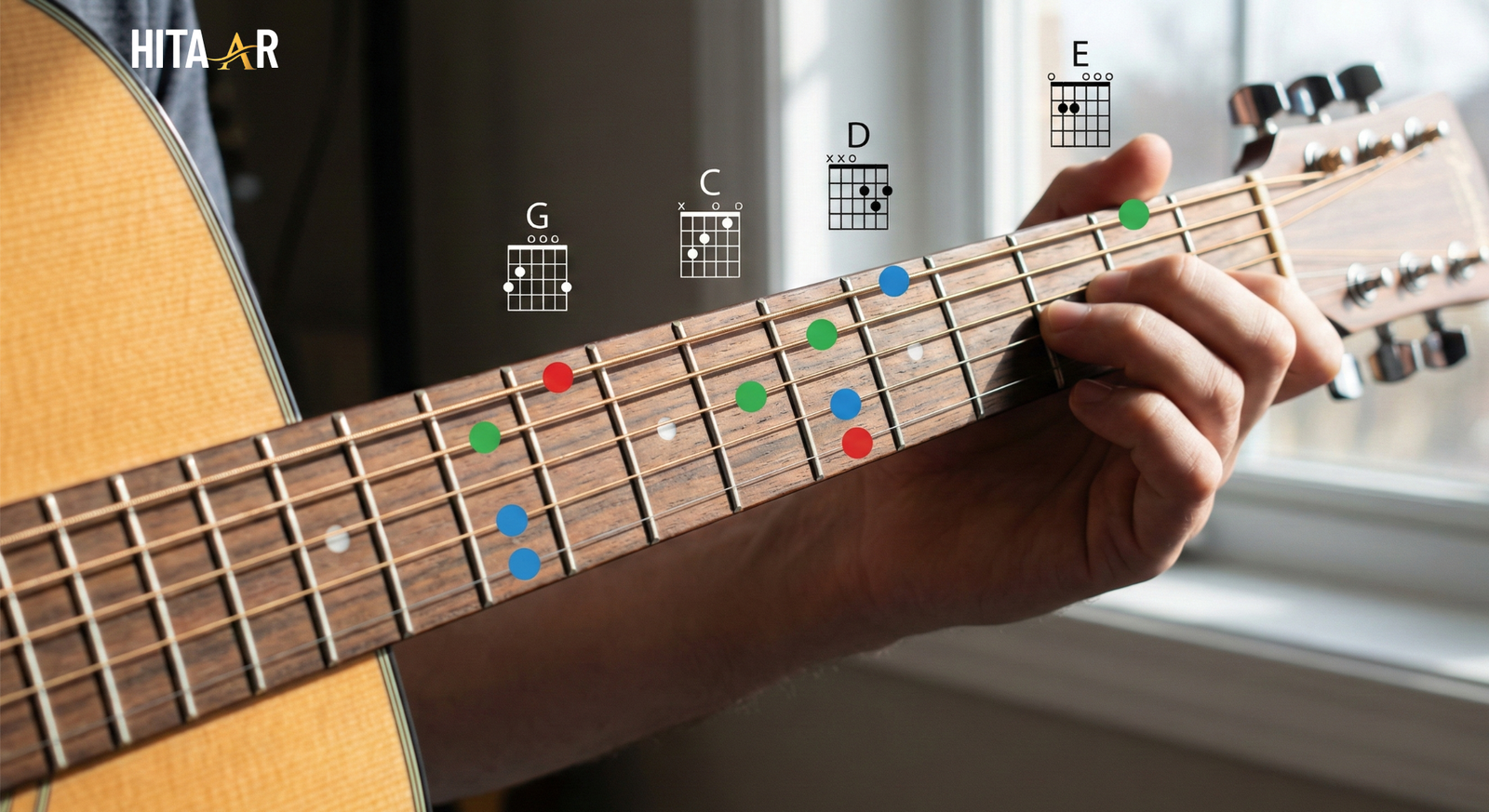
These are the open chords — they use open strings and are easy to form. Learn the finger positions, then move to simple progressions.
Moving on: barre chords & shapes (take chords to the next level)
Barre chords use one finger to press multiple strings — great for changing keys without a capo and essential for rock, pop, and many acoustic versions (Rolling Stones, Nirvana, Oasis).
Common barre shapes
E-shape barre (root on low E): Moveable power for major/minor (barre at any fret).
A-shape barre (root on A): Great for full, ringing major chords when barring at the 5th or 7th fret.
m7 and minor barre variations for soulful and pop voicings.
Extended chords and colors — add9, maj7, sus2/sus4
These give acoustic guitar songs their character (think John Mayer, Jack Johnson, Taylor Swift acoustic versions).
add9: adds a 2nd an octave higher; great for “folk/pop” shimmer.
maj7: sweet, jazzy color (used in ballads).
sus2 / sus4: open, unresolved sound — common in strummed songs.
Strumming patterns & rhythm (step-by-step)
Rhythm makes chords come alive. Use simple patterns, then add complexity.
Downstrokes only (4/4): D D D D — practice on each chord for timing.
Down-up pattern: D D U U D U — very common for acoustic songs.
Palm mute & accents: mute slightly near the bridge for percussive beats.
Use a metronome or click to keep a steady beat; start slow, then speed up.
Fingerpicking & flatpicking basics
Two paths to solo acoustic tone:
Fingerpicking: use thumb for bass (E/A/D strings) and fingers for melody on top strings — great for folk (Bob Dylan, Neil Young, Jim Croce).
Flatpicking: use a pick for arpeggio runs and melody (common in country and bluegrass — e.g., “Wagon Wheel”).
Step-by-step fingerpicking pattern example (thumb, index, middle, ring):
Thumb on 5th string (A), index on 3rd, middle on 2nd, ring on 1st — repeat slowly and sync to chord changes.
Reading tabs & chord charts (how to use full tabs and charts)
Chord charts show finger positions (like the open chord diagrams above).
Tabs show string-by-string which frets to play — great for riffs and intros (e.g., “Jet Plane” intro).
Video lessons + tabs: combine a video lesson showing finger placement with full tabs for self-study.
Popular song examples with chord progressions (playable at beginner level)
Below are simple progressions and song examples (no full lyrics reproduced — chord-based roadmaps):
1) “Leaving on a Jet Plane” (John Denver) — easy progression
| G | C | G | C | — try simple down-up strum.
2) “Knockin’ on Heaven’s Door” (Bob Dylan) — classic 4-chord
| G | D | Am7 | G | — repeat.
3) Simple pop ballad progression (used by many artists)
| C | G | Am | F | — used widely (Tom Petty, Taylor Swift versions).
4) “Hey Jude” / Beatles style (examples of chord movement)
Use C → G → Am → F progressions and simple arpeggios.
Practice plan — step by step (many hours × consistent practice)
Week 1–2 (Beginners)
15–20 min: Warmup (open strings, single-note scales)
20 min: Learn 3 open chords (G, C, D) and practice smooth changes
10 min: Learn one strumming pattern, play along with a slow song
Week 3–6 (Foundation)
15 min: Add E, A, Am, Em
20 min: Practice D-U patterns and palm muting
20 min: Start simple fingerpicking patterns on Em and C
Month 2+ (Next level)
Introduce barre chords (E-shape and A-shape)
Add two extended chords (add9, maj7) and use in progressions
Work with video lessons and full tabs for one song per week
Acoustic Guitar Chords
Song arrangement tips (acoustic guitar specific)
For a fuller sound, combine bass thumb + strum hand accents.
Use a capo to match a singer’s range without changing familiar chord shapes.
When arranging a pop/rock song for acoustic guitar, simplify the chord progression and add a simple fingerpicked intro.
Common alternate tunings & how they change chords
Alternate tunings open new chord shapes and voicings — used by many acoustic players (Neil Young, Rod Stewart styles).
Open G (D G D G B D): great for slide and droning chords (Rolling Stones flavor).
Drop D (D A D G B E): deeper bass tone, easy power chords.
DADGAD: modal, popular in folk and Celtic-influenced acoustic music.
Common mistakes and how to fix them
Muted or buzzing strings: press closer to the fret, keep thumb behind the neck.
Slow chord changes: practice slow transitions with a metronome; isolate problem changes.
Rushing the strum: count out loud or use a click/metronome.
Hand soreness: build calluses gradually; warm up before long sessions.
Tools & gear that help you learn (acoustic guitar strings, picks, capo, guitars)
String gauge: lighter strings are easier for beginners; later move to medium for a fuller sound.
Capo: instant key changes without learning new shapes.
Digital tuner + metronome: essential for timing and tuning.
Recommended acoustic models: Martin D-18 (legendary, premier quality tone), other mid-range acoustics for practice.
Frequently Asked Questions
Q: What are the best chords to learn first on an acoustic guitar?
A: Start with G, C, D, E, A, Am, and Em. These open chords unlock hundreds of songs.
Q: How long to learn basic chords?
A: With daily 20–30 minutes practice, beginners often play simple songs within 2–4 weeks.
Q: Should I use a capo or learn barre chords?
A: Use a capo to quickly change key. Learn barre chords to gain freedom across the neck.
Q: Where can I find video lessons and full tabs?
A: Use reputable sites and YouTube channels; pair video lessons with full tabs and chord charts for accuracy.
Quick reference: chord progression cheat sheet
I-V-vi-IV (C-G-Am-F) — ubiquitous pop progression.
I-IV-V (G-C-D) — classic rock/country.
vi-IV-I-V (Am-F-C-G) — emotive ballads.
I-vi-IV-V — doo-wop and classic tunes.
Final tips & next steps (actionable)
Choose 5 songs you love that use simple chord progressions (Beatles, John Denver, Jack Johnson, Jim Croce, Neil Young).
Practice chord transitions slowly with a metronome; increase tempo only once clean.
Record yourself (phone) and compare to original recordings to work on timing, tone, and strumming.