






Introduction
Warehouse management rarely makes headlines, yet it quietly decides whether modern commerce runs smoothly or falls apart. Behind fast deliveries and accurate orders sits a system under constant pressure: more SKUs, tighter margins, higher customer expectations, and a workforce that must learn complex processes quickly.
It’s in this context—not as a trend, but as a response—that augmented reality (AR) and virtual reality (VR) have entered warehouse operations. These technologies didn’t arrive because they were exciting. They arrived because traditional tools were no longer enough.
How Augmented Reality and Virtual Reality Are Transforming Modern Warehouse Management
What feels different about AR and VR in warehouses is not the technology itself, but the way it shifts human attention. Instead of asking workers to constantly look away—from shelves to screens, from instructions to paperwork—AR overlays information directly onto the physical environment. VR, on the other hand, removes the environment entirely, allowing training and simulation without real-world risk.
This change matters more than it first appears. Warehouses are fast, physical, and error-sensitive spaces. Any tool that reduces cognitive load—even slightly—can compound into meaningful productivity and safety gains over time. AR and VR don’t replace workers; they reshape how workers interact with space, data, and decisions.
What Are Augmented Reality and Virtual Reality Applications in Warehouse Management?
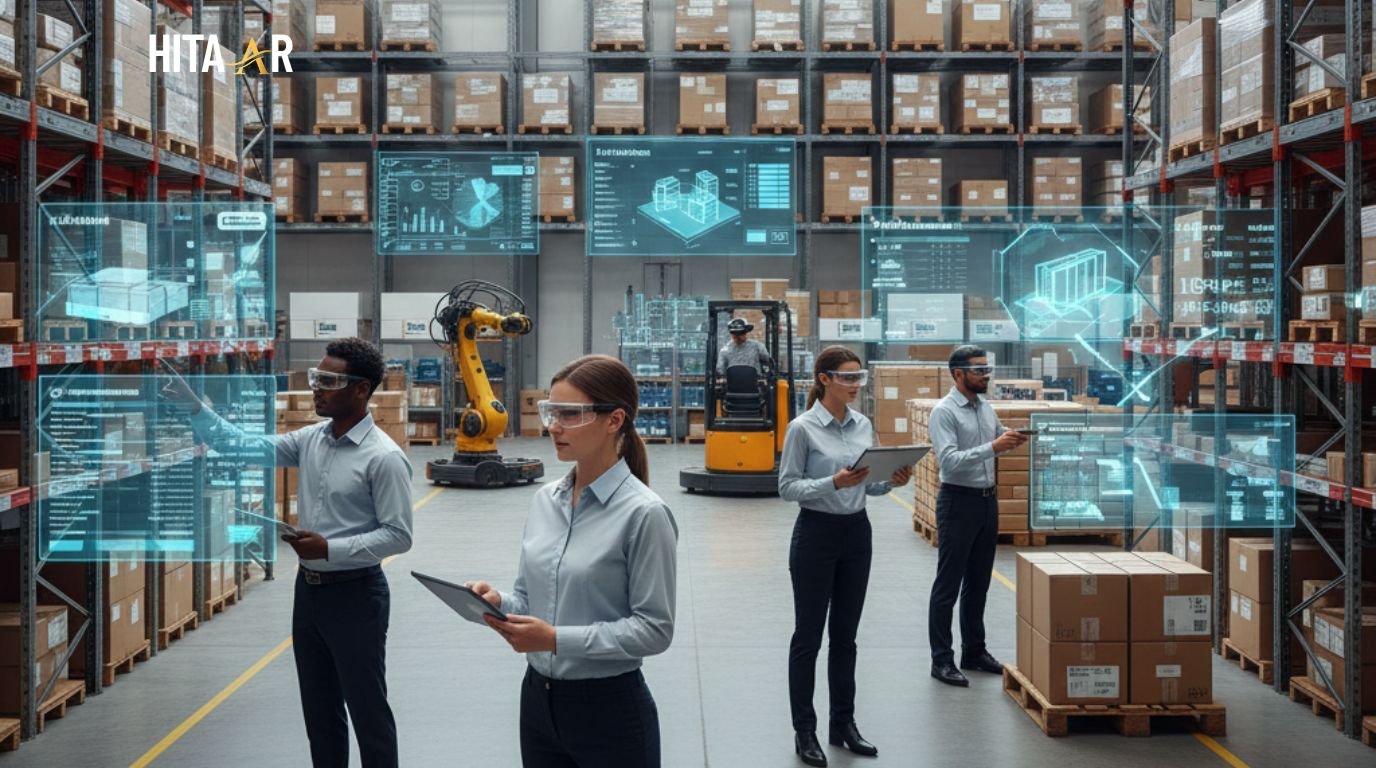
Augmented reality applications in warehouse management typically involve wearable devices—smart glasses, head-mounted displays, or mobile devices—that overlay digital instructions onto real warehouse environments. A picker sees directions, item quantities, or bin locations without stopping to check a handheld scanner.
Virtual reality applications work differently. They create simulated warehouse environments used mainly for training, layout planning, and safety drills. New hires can learn workflows without disrupting operations, and managers can test process changes before implementing them on the floor.
What’s easy to miss is that these applications are not futuristic experiments anymore. They are operational tools, increasingly integrated with warehouse management systems (WMS), inventory software, and analytics platforms.
Why Warehouses Are Rapidly Adopting AR and VR Technologies
The adoption curve is driven less by innovation and more by necessity. Labor shortages, high turnover, and the rising cost of errors make traditional training and manual processes expensive.
AR reduces dependency on long onboarding cycles. VR minimizes training risks and downtime. Together, they address problems warehouses already have—rather than introducing new ones.
How Is Augmented Reality Used in Warehouse Operations?
AR is most effective where speed and accuracy compete. Order picking, cycle counting, and replenishment tasks benefit immediately because workers receive real-time guidance. Visual cues replace printed lists, and confirmations happen automatically.
What stands out is not the technology’s complexity, but its restraint. The best AR systems don’t overwhelm users with data. They show only what’s necessary, when it’s necessary—a design choice that feels deliberate rather than decorative.
What Role Does Virtual Reality Play in Warehouse Training and Safety?
VR excels where mistakes are costly. Training forklift operators, teaching emergency procedures, or simulating high-risk environments can all happen without real-world consequences.
There’s also a quieter benefit: confidence. Workers trained in VR often perform better because they’ve already “been there,” even if the experience was simulated.
Can AR and VR Improve Picking, Packing, and Inventory Accuracy?
Evidence from logistics providers suggests they can. Visual verification, guided workflows, and reduced manual input lower error rates. It’s hard to ignore that many warehouse mistakes stem from fatigue and distraction—factors AR directly addresses.
Are AR and VR Cost-Effective Solutions for Warehouse Management?
This is where hesitation is reasonable. Upfront costs exist, and not every operation benefits equally. But when evaluated over time—reduced errors, faster onboarding, lower injury rates—the return often becomes clearer. Cost-effectiveness depends less on technology and more on thoughtful implementation.
Real-World Examples of Augmented and Virtual Reality in Warehouse Management
Logistics companies have deployed AR smart glasses for order picking, while retailers use VR to train seasonal workers before peak demand. These aren’t pilot projects anymore; they are scaled systems embedded in daily operations.
Case Studies: Companies Successfully Using AR and VR in Warehousing
Large distribution centers report measurable improvements in pick rates and reduced training times. What’s notable is that success often follows restraint—rolling out AR for a single task before expanding.
Common Warehouse Tasks That Benefit Most From AR and VR
Picking, packing, inventory audits, safety training, and equipment operation consistently show strong results. Tasks requiring spatial awareness and repetition tend to benefit most.
Augmented Reality and Virtual Reality Applications in Warehouse Management (PDF Guide)
PDF guides are typically used for internal training, compliance documentation, and executive overviews. A well-designed guide focuses less on features and more on workflow impact.
Presentation-Ready Overview: AR and VR Applications in Warehouse Management (PPT)
PPT formats work best for stakeholder alignment—explaining why a solution matters before explaining how it works. Clarity here often determines adoption success.
Open-Source Projects and Code: AR & VR Warehouse Management on GitHub
GitHub repositories show how AR and VR integrate with WMS platforms, sensors, and APIs. They are particularly useful for teams exploring custom or hybrid solutions rather than off-the-shelf products.
Key Technologies Behind AR and VR Warehouse Solutions
Computer vision, spatial mapping, real-time data synchronization, and cloud connectivity form the backbone. These systems are only as effective as their integration with existing infrastructure.
Hardware and Software Needed for AR- and VR-Enabled Warehouses
AR glasses, VR headsets, mobile devices, backend software, and secure networks are standard components. The choice depends on task complexity and environmental constraints.
Challenges and Limitations of Using AR and VR in Warehouse Management
Adoption resistance, device comfort, battery life, and data accuracy remain real challenges. Ignoring them often leads to failed pilots.
Augmented Reality vs Virtual Reality in Warehouse Management: What’s the Difference?
AR supports live operations; VR supports preparation and planning. Confusing the two often leads to mismatched expectations.
When to Use AR and When VR Makes More Sense in Warehousing
Use AR when workers need guidance in real time. Use VR when learning, testing, or practicing without risk.
The Future of Augmented and Virtual Reality in Warehouse Management
The future points toward lighter devices, better integration, and more adaptive systems. The technology will likely disappear into the workflow rather than stand out.
How AI, IoT, and AR/VR Are Shaping Smart Warehouses
AI analyzes, IoT senses, AR guides, and VR prepares. Together, they form systems that respond rather than react.
How to Choose the Right AR or VR Solution for Your Warehouse
Start with one problem, not one product. Technology should follow workflow, not lead it.
ROI and Productivity Gains From AR and VR Warehouse Applications
ROI shows up gradually—in fewer errors, faster training, and safer operations. It’s cumulative rather than immediate.
Conclusion
It may be tempting to call AR and VR “the future,” but that framing misses the point. They are tools for solving present problems—labor constraints, complexity, and scale.
Their value doesn’t come from novelty. It comes from restraint, thoughtful use, and respect for how people actually work. And that, more than any technology, is what makes systems last.
Find related news and background information on hitaar.